New Horizons
 Project Management Academy
 Six Sigma Online
 TCM Security
 TRACOM
 Velopi
 Watermark Learning
 Login
Login



Imagine your company is preparing to implement a new AI-driven platform that promises to streamline operations and increase efficiency. However, you realize that most of your employees lack the necessary skills to fully leverage the technology. As deadlines approach, the pressure mounts on HR and L&D teams to quickly upskill the workforce and ensure everyone is ready to meet the demands of this new system.
This scenario underscores the critical need to stay ahead of emerging technologies while promoting ongoing professional growth. Ensuring your workforce has the right mix of technical and soft skills is essential for maintaining a competitive edge. Organizations must proactively develop strategies that drive skill development and professional growth, aligning with both business goals and employee aspirations.
In this blog, we’ll help HR leaders address these challenges by sharing valuable examples of how to create tailored training programs. We’ll focus on key areas like AI, cloud computing, and cybersecurity, preparing your teams for the demands of the modern workplace. Additionally, we’ll explore professional development approaches—from leadership training to mentoring programs—that foster both technical and interpersonal growth.
Key Takeaways:
- Balanced Skill Development: Technical skills (e.g., AI, cloud computing) combined with soft skills (e.g., communication, adaptability) are essential for handling both technology and workplace dynamics.
- Professional Growth Programs Boost Success: Tailored development programs enhance employee performance and align skills with organizational goals, as seen in examples like Netflix and Microsoft.
- Continuous Learning Ensures Competitiveness: A culture of lifelong learning keeps organizations resilient and employees prepared for evolving industry demands.
Professional Development Examples
When building professional development programs, it is essential that you provide training that balances technical and soft skills. Technical skills refer to specific knowledge and expertise in data analysis, cybersecurity, or project management. These skills are essential for completing tasks and meeting job requirements. In contrast, soft skills encompass interpersonal abilities such as communication, leadership, and adaptability, which are crucial for effective collaboration and navigating workplace dynamics.
In the following sections, we will examine both technical and soft skills in more detail.
Technical Skills Development
Technology evolves quickly, leading to a growing demand for technical IT skills in AI, cloud computing, and cybersecurity. To stay ahead of technology advancements, your organization must ensure its employees have access to the latest knowledge and hands-on experience in these growing fields. To increase your employees’ expertise and productivity, create structured training programs that provide IT certification opportunities, and practical experience scenarios.
Let’s look at Netflix and how it embraced technological change and increased customer satisfaction through improved use of technology.
Example: Data Science and AI at Netflix
Netflix, a global leader in video streaming, faced the challenge of retaining customers while providing personalized recommendations to keep users engaged. With an extensive library of shows and movies, it was crucial for Netflix to deliver content that aligned with user preferences to maintain subscriber loyalty.
Technical Skill in Action: Data Science & Artificial Intelligence (AI)
To improve customers’ experience, Netflix’s data science and AI teams utilized machine learning and data analytics to create a powerful recommendation engine. For personalized recommendations, they used advanced algorithms to analyze vast amounts of user data—such as watch history, browsing behavior, and even the time of day users watch content.
- Skill Application: The team applied their data science and AI skills to design and implement sophisticated recommendation algorithms, such as collaborative filtering and deep learning models, which predict what content a user might like based on patterns in their and others’ viewing habits. They also used A/B testing to continually optimize the algorithms based on real-time feedback and data.
- Impact: Netflix’s recommendation engine now drives approximately 80% of the content watched on the platform. This personalized experience has significantly increased customer satisfaction, engagement, and retention. Netflix’s AI and data-driven approach has dramatically affected its growth, from 75 million subscribers in 2015 to over 238 million globally by 2023.
Below are some of the most in-demand technical skills and how your organization can help employees develop them:
| Technical Skill | Description | How Organizations Can Develop This Skill for Employees |
| Artificial Intelligence (AI) & Machine Learning (ML) | Building intelligent systems that learn from data to make predictions and decisions. | Offer in-house AI/ML training sessions with expert instructors. Provide access to online courses Sponsor certifications (AWS, Google, or Microsoft AI/ML certs). Encourage employees to work on AI/ML projects through internal innovation programs. |
| Cloud Computing | Managing and deploying applications and services via the cloud (AWS, Azure, GCP). | Partner with cloud service providers for employee training. Provide access to cloud labs for hands-on experience (AWS, Azure, GCP sandbox environments). Sponsor certifications (AWS Certified Solutions Architect, Azure Administrator, etc.). Include cloud-based projects in ongoing internal development efforts. |
| Cybersecurity | Protecting networks, systems, and data from attacks and vulnerabilities. | Offer in-house cybersecurity training programs (e.g., ethical hacking, penetration testing). Provide access to industry-recognized certifications (CompTIA Security+, CISSP, etc.). Establish a mentorship program with senior cybersecurity professionals. Facilitate participation in external security conferences and Capture the Flag events. |
| Data Science & Analytics | Analyzing and interpreting complex data to help organizations make decisions. | Provide access to data analytics platforms (e.g., Power BI, Tableau) for hands-on experience. Organize data science bootcamps or workshops. Sponsor employees’ pursuit of data science certifications. Encourage collaboration on cross-departmental data projects. |
| DevOps | Combining software development and IT operations to shorten the development lifecycle. | Offer DevOps workshops on automation and tool integration (Docker, Jenkins, Kubernetes). Facilitate continuous learning through online learning platforms and certifications (AWS DevOps Engineer, Docker Certified Associate). Encourage team-based projects to implement DevOps pipelines in real-world scenarios. |
Soft Skills Development
While technical skills are essential for your employees to complete specific tasks, soft skills also play a critical role in their ability to build interpersonal relationships. These skills, including communication, leadership, and conflict resolution, are essential for them to build strong relationships, foster collaboration, and ensure smooth interactions within their team. Soft skills will enable your employees to effectively lead a group, handle difficult conversations, or solve interpersonal issues.
Let’s look at how Microsoft embraced soft skills to transform how it approached leadership.
Example: Leadership During Crisis – Microsoft’s Satya Nadella
When Satya Nadella took over as CEO of Microsoft in 2014, the company faced significant challenges. Its internal culture was competitive rather than collaborative, and the company had missed significant shifts in the tech industry, including mobile and cloud computing.
Nadella demonstrated transformational leadership by fostering a growth mindset across the organization. He shifted Microsoft’s focus toward innovation, collaboration, and learning from failure. A pivotal move was leading Microsoft’s transition from traditional software sales to a cloud-based model through Azure, now one of the largest global cloud service platforms.
- Skill Application: Nadella used empathy and clear communication to break down internal silos. He encouraged a culture of learning rather than perfection, motivating employees to innovate and take calculated risks. His leadership helped Microsoft pivot from a software company to a leader in cloud services, artificial intelligence, and hardware solutions.
- Impact: Under Nadella’s leadership, Microsoft’s market capitalization grew from around $300 billion in 2014 to over $2.5 trillion in 2023. His emphasis on collaboration, adaptability, and empathy turned around Microsoft’s culture, making it one of the most valuable companies in the world and an innovation leader.
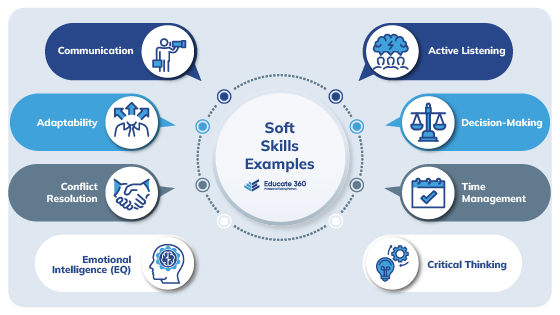
| Soft Skill | Description & Importance | How to Develop Employees |
| Leadership | The ability to guide and motivate teams toward achieving goals. Essential for advancing into management roles and driving team performance. | Offer leadership development programs. Provide mentorship and coaching opportunities. Assign leadership roles in projects. |
| Communication | Effectively exchanging information, both verbally and in writing. Crucial for collaboration, negotiation, and influencing others in the workplace. | Conduct communication workshops. Encourage participation in presentations and team meetings. Offer feedback on communication styles. |
| Active Listening | Fully concentrating and engaging with what others are saying. Enhances relationships, improves problem-solving, and builds trust within teams. | Provide training on active listening techniques. Role-play scenarios for listening in conflict situations. Promote open feedback sessions. |
| Adaptability | The ability to adjust to new conditions or changes in the workplace. Vital in dynamic environments to ensure resilience and flexibility. | Include adaptability challenges in training (e.g., simulated scenarios). Promote job rotations or cross-functional team experiences. Encourage employees to participate in change management projects. |
| Decision-Making | Choosing the best course of action from available options. This is critical for leadership roles and managing complex projects or challenges. | Provide decision-making workshops and case studies. Offer opportunities to make decisions in low-risk environments. Include decision-making tasks in real projects. |
| Conflict Resolution | The ability to manage and resolve disagreements constructively. Critical for maintaining a positive work environment and fostering healthy collaboration. | Conduct conflict resolution workshops. Use role-playing exercises for conflict scenarios. Provide training on negotiation and mediation techniques. |
| Time Management | Prioritizing tasks and managing time efficiently to meet deadlines. Increases productivity, reduces stress, and ensures consistent project delivery. | Offer time management training and tools (e.g., project management software). Encourage goal-setting and prioritization exercises .Provide one-on-one coaching for time management strategies. |
| Emotional Intelligence (EQ) | Recognizing and managing one’s own emotions while understanding those of others. This improves interpersonal relationships, leadership, and conflict resolution. | Offer emotional intelligence training and self-awareness workshops. Provide feedback through 360-degree reviews. Foster a supportive culture of empathy and open communication. |
| Critical Thinking | Analyzing situations logically to make informed decisions. Crucial for problem-solving and making strategic decisions in business environments. | Provide problem-solving and critical thinking workshops. Encourage participation in brainstorming sessions. Use real-world case studies for analysis. |
| Teamwork | Working effectively with others to achieve a common goal. Contributes to a positive organizational culture and is necessary for collaborative projects. | Promote collaborative projects and team-based work. Conduct team-building activities and workshops. Encourage cross-departmental collaboration. |
| Creativity and Innovation | Generating new ideas or improving existing processes. Drives innovation and helps companies stay competitive by fostering new solutions. | Offer creativity workshops and innovation challenges. Encourage participation in brainstorming and idea-generation sessions. Provide time for employees to work on passion projects. |
| Networking | Building and maintaining professional relationships. Enhances career opportunities, facilitates partnerships, and encourages knowledge sharing. | Facilitate networking events and conferences. Encourage participation in industry forums and online communities. Create mentorship programs to expand professional networks. |
| Presentation Skills | The ability to convey information clearly and engagingly to an audience. This is vital for influencing stakeholders, sharing ideas, and communicating effectively in meetings. | Offer presentation and public speaking training. Provide opportunities to present in team meetings or to leadership. Encourage peer feedback on presentations. |
Conclusion
Skills development, learning and development, and professional growth are essential to success in today’s dynamic workplace. Whether focused on mastering technical skills, honing your leadership abilities, or fostering a culture of continuous learning, these investments in your development can profoundly impact your career.
By focusing on technical and soft skills, embracing lifelong learning, and cultivating professional development strategies, your organization can remain competitive, adaptable, and prepared for future challenges. Whether through formal training, mentorship, or self-driven learning, the path to personal and professional growth is ongoing.
As you move forward, remember that the commitment to developing new skills enhances your employees’ job performance and opens the door to new opportunities, leadership roles, and personal fulfillment. Encourage a mindset of continuous improvement within your organization to help navigate the evolving demands of the modern workplace.